





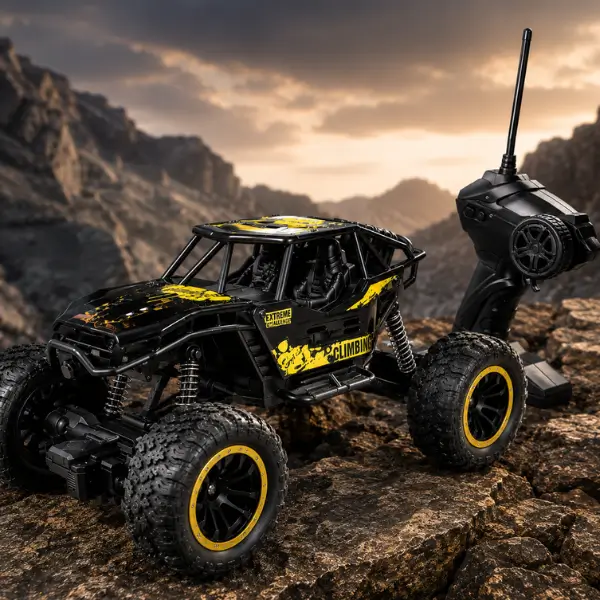
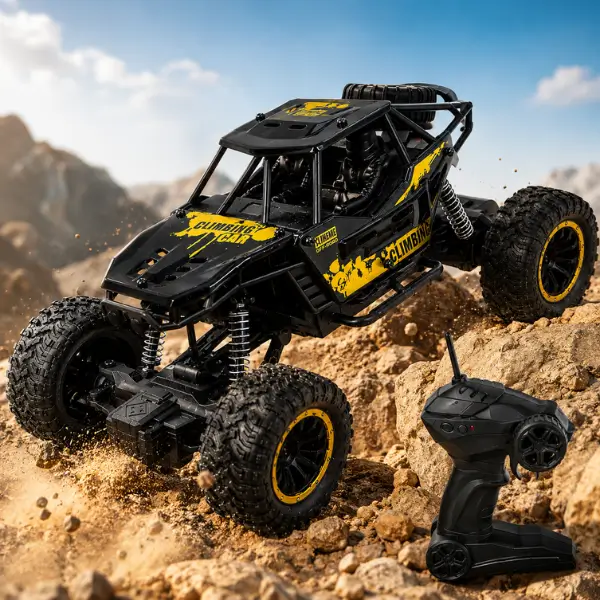

Regular remote control cars are fun on smooth floors — but the moment they hit gravel, grass, or a bumpy backyard, they stall out. That's exactly the gap a rock crawler fills. Built with rugged tires, a low-geared 4x4 drivetrain, and a chassis that can flex over uneven terrain, a rock crawler is the RC toy made specifically for the surfaces regular cars can't handle.
What Is a Rock Crawler RC Car?
A rock crawler rc car is a 4-wheel-drive remote control vehicle engineered for slow, controlled movement over rocks, dirt mounds, curbs, and other obstacles — rather than speed. Where a typical RC car is built to go fast on flat ground, a rock crawler 4x4 is built to go anywhere, at a crawl, without flipping or getting stuck.
What sets it apart from a standard RC car:
| Feature | Standard RC Car | Rock Crawler RC Car |
|---|---|---|
| Drivetrain | Usually 2WD | 4WD — all wheels powered |
| Tires | Smooth, road-focused | Deep-tread, off-road grip |
| Best surface | Flat floors, smooth roads | Rocks, gravel, grass, dirt |
| Speed focus | High speed | Low speed, high torque |
| Ground clearance | Low | Higher, built for obstacles |
Why 4WD Actually Matters
The "4x4" in rock crawler 4x4 isn't just a spec on a box — it's the entire reason the toy works where others don't.
- Power to all four wheels means the car can keep pushing forward even when one or two wheels lose grip on loose gravel or an uneven surface
- Better traction on inclines — climbing over a small rock or a grassy bump needs power distributed across every wheel, not just two
- Reduced tipping and stalling — 4WD keeps the car more stable when it's navigating obstacles at an angle, instead of digging in and getting stuck
In short: if the plan is anything beyond a flat living room floor, 4WD isn't optional — it's the whole point of buying a rock crawler over a regular RC car.
Key Features to Check Before Buying
Not every listing gives you the full picture. Here's what actually determines how good a rock crawler remote control car is:
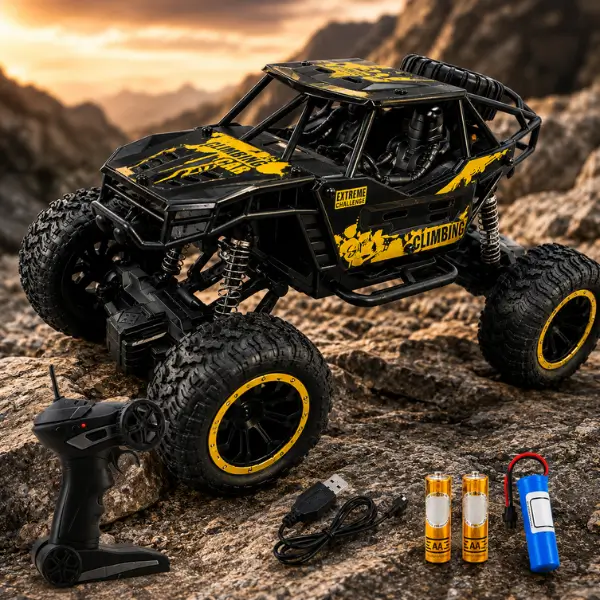
- Battery type and charging — rechargeable via USB is now standard; check the charging time and expected play time per charge before buying
- Controller battery requirement — most remotes run on separate AA/AAA batteries, which usually aren't included, so plan to have some on hand
- Control range — look for at least 25–30 meters for comfortable outdoor play
- Scale and size — smaller scales (like 1:16) are easier for younger kids to handle indoors; larger scales handle outdoor terrain more confidently
- Assembly state — most rock crawlers today are "almost ready to run," needing just a battery and quick setup, not full assembly
- Age recommendation — genuinely important here, since crawler-style cars involve more moving parts and stronger motors than a basic toy car
How Long Does It Run and Charge?
This is the detail buyers most want to know and listings most often bury:
| Detail | Typical Range |
|---|---|
| Charging time | 45–60 minutes |
| Play time per charge | 20–25 minutes |
| Control distance | Around 30 meters |
Practical tip: treat the play time as a per-session number, not an all-day one. If your child plays for extended stretches, having a second battery on hand (where compatible) avoids the mid-play "it died" moment.
Indoor vs Outdoor: Where Does a Rock Crawler Perform Best?
Indoors: works fine on hard floors and low-pile carpet, though the whole appeal of the deep-tread tires and 4WD system is somewhat wasted on a flat surface.
Outdoors: this is where a rc rock crawler 4x4 actually shows what it's built for — gravel driveways, grassy yards, small dirt mounds, and light obstacle courses made from books, boxes, or backyard rocks.
A simple way to think about it: a regular RC car is an indoor toy that can survive going outside. A rock crawler is an outdoor toy that also happens to work indoors.
Is It Age-Appropriate? Safety Notes for Parents
- Recommended age: most rock crawlers are suited to 6 years and up, given the stronger motor and more involved controls compared to a basic push toy
- Supervision for younger kids: for children on the younger end of the range, having an adult handle initial charging and control calibration helps avoid frustration
- Outdoor supervision: obstacle courses are part of the fun, but keep play away from roads, water, or steep drop-offs
- Battery handling: charging should always be done with the included USB cable, away from direct sunlight or heat
Frequently Asked Questions
What's the difference between a rock crawler and a monster truck toy?
A rock crawler is built for slow, controlled climbing over obstacles at low speed with maximum traction. A monster truck toy is built for speed and jumps. Both are 4WD, but they're optimized for opposite goals.
Can a rock crawler rc car handle grass and dirt?
Yes — that's the terrain it's designed for. Deep-tread tires and 4WD power are specifically built to maintain grip on loose or uneven outdoor surfaces.
Do I need to buy batteries separately?
The car's main battery is usually rechargeable and included. The remote controller, however, typically needs its own AA or AAA batteries, which are commonly sold separately — worth checking before gifting it.
Is a rock crawler good for a first-time RC car buyer?
Yes, especially for kids who spend more time outdoors than indoors. The lower speed and higher stability make it a more forgiving first RC toy than a high-speed racer.
How rough can the terrain be before the car gets stuck?
Small rocks, curbs, grassy bumps, and light dirt mounds are well within range for most rock crawlers. Deep mud, tall grass, or steep inclines are usually beyond what a toy-grade 4x4 can handle.
Final Verdict
A rock crawler earns its price over a standard RC car the moment play moves off a smooth floor. The 4WD drivetrain, rugged tires, and low-speed control are built for exactly the terrain regular toy cars avoid — gravel, grass, small obstacles, uneven ground. If the plan is backyard play rather than living-room laps, this is the category to buy from. Just go in clear-eyed on play time per charge, keep spare controller batteries on hand, and match the age recommendation to the child using it.

Reviews
There are no reviews yet.